
- Buy Crypto
- Markets
- Futures
- Spot
- Copy Trade
 Earn
Earn- More
Can the Nakamoto Upgrade and sBTC Empower Stacks to Further Lead the Bitcoin Ecosystem?

Bitcoin breaking $100,000 seems to be just around the corner, and the community is eagerly anticipating the development of the Bitcoin ecosystem.
Although the performance of related ecosystem tokens has not been dazzling, U.S. compliant trading platforms such as Coinbase and Kraken have recently issued cbBTC and KBTC respectively. Industry giants' exploration of the Bitcoin ecosystem has never stopped. Whether compared to other chains or its own nearly $2 trillion market capitalization, the Bitcoin ecosystem still has a long way to go but also holds tremendous development opportunities.
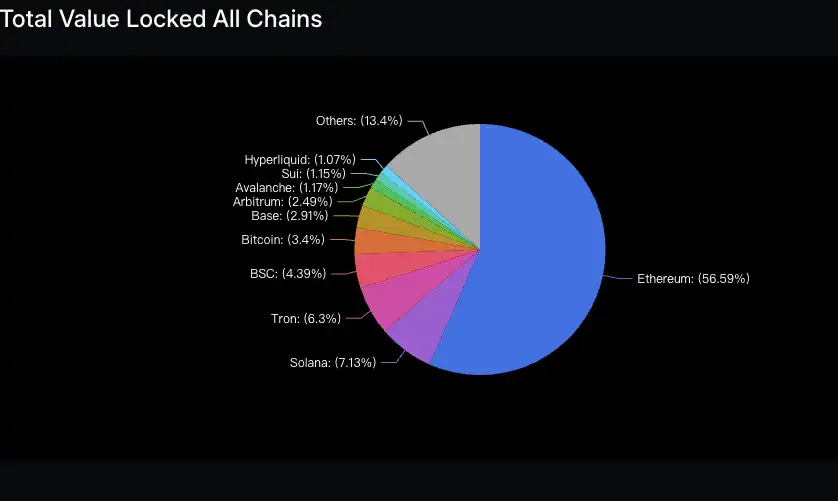
Percentage of total TVL each chain holds, with the Bitcoin ecosystem accounting for only 3.4%
From a secondary market perspective, hot money in the market has always had the need for race rotation and switching from highs to lows. In the Bitcoin ecosystem, Stacks, as a leader in this field, has become the best representative of exploration in the Bitcoin ecosystem. Stacks has continuously built technology and ecosystem from scratch, which is particularly solid and impressive in the current market environment.
Recently, the Ripple and SEC case has come to a temporary conclusion, coupled with the resignation of the SEC chairman triggering a super bull market for XRP. Like Ripple, Stacks is also a compliant representative in the crypto industry. In July 2024, the U.S. Securities and Exchange Commission (SEC) terminated its investigation into Stacks and Hiro. Moreover, Stacks is the first token issuance project ever approved by the SEC.
Stacks' Technological Iteration Journey
The Smart Contract Dream on Bitcoin: From Blockstack to Stacks
Stacks' history can be traced back to Blockstack, founded by Muneeb Ali and Ryan Shea from Princeton in 2013. Blockstack, as the initial v1 version, aimed to create a decentralized Internet ecosystem, replacing traditional cloud computing with a distributed computing network. At that time, Blockstack had a large number of DApps.
By 2021, Blockstack's v2 version, now known as the Stacks mainnet, was officially launched. At this point, the team's goal underwent a significant transformation—from serving a decentralized Internet to empowering Bitcoin. Through the Stacks protocol, developers can build applications with smart contract functionality on the Bitcoin network without altering Bitcoin itself. Throughout this process, Stacks inevitably faced criticism from Bitcoin "maximalists," but Muneeb consistently and tirelessly conveyed the vision of Stacks to the community.
PoX and Clarity: Deeply Integrating Bitcoin with Stacks
The reason Stacks can securely integrate with Bitcoin is thanks to its innovative Proof of Transfer (PoX) consensus mechanism. At the core of the PoX mechanism is the idea of allowing miners to participate in Stacks block mining by transferring Bitcoin, rather than relying on competitive hash power expenditure. This way, Stacks not only inherits the security of the Bitcoin network but also makes Bitcoin holders direct participants in the ecosystem.
Compared to traditional Proof of Stake (PoS), the design philosophy of PoX is more in line with the decentralization spirit of Bitcoin. In a unique way, it transfers the value of Bitcoin to the Stacks ecosystem, creating a close economic bond between the two. For miners, the PoX mechanism provides a new way to capture value, and for developers, this deep integration also gives them greater confidence when implementing smart contracts on the Bitcoin network.

Alongside the launch of the Stacks mainnet came Clarity, a smart contract language designed specifically for Bitcoin. Clarity is a non-Turing complete language, meaning it focuses on implementing verifiable functions while avoiding the uncertainty of complex computations. When using Clarity, developers can preview the outcome of smart contracts in advance, greatly reducing the risk of unexpected behavior. Additionally, Clarity runs directly on the chain, avoiding vulnerabilities that traditional smart contract compilers may introduce. This language designed for Bitcoin lays the foundation for DeFi, NFTs, and other complex applications.
Nakamoto Upgrade: Faster, More Stable, More Secure
Just as there is no perfect code, Stacks also has room for improvement on its journey to expand Bitcoin.
The original design of Stacks tied block production to Bitcoin blocks, causing slow block production to result in high latency, where even microblocks could not completely solve the problem. Furthermore, the security of the Stacks network was not entirely tied to Bitcoin, as the cost of reorganizing the last N blocks of the Stacks blockchain was the cost of generating the next N + 1 Stacks blocks. This cost was lower compared to a 51% attack on Bitcoin.
Given this, in 2024, Stacks introduced the "Nakamoto Upgrade" and officially completed the upgrade on October 29th. The significance of this upgrade goes beyond technical optimization; it is a crucial step towards the prosperity of the Bitcoin ecosystem.

In the just-concluded month of November, the on-chain transaction volume of Stacks hit a recent high
Rapid Block Confirmation: Optimizing User Experience
The Nakamoto Upgrade introduces a rapid block confirmation mechanism, allowing users to achieve near real-time transaction confirmation on Stacks. Microblocks and Bitcoin anchor blocks will be eliminated, replaced by continuously produced Stacks blocks, enabling miners to produce multiple blocks during a Bitcoin block, significantly improving transaction speed.
The time required for a user-submitted transaction to be confirmed in a block is now reduced from 10 to 40 minutes to approximately 5 seconds, not only improving network efficiency but also opening the door to high-frequency trading and instant payment scenarios.
Bi-Directional Verification: Enhancing Security
Post-upgrade, Stacks has implemented a bi-directional verification mechanism, requiring miners to be active on both the Bitcoin and Stacks networks simultaneously. This design enhances network security while ensuring the collaborative relationship between the two chains. For attackers to manipulate Stacks data, they must control the consensus of the Bitcoin network concurrently, significantly raising the cost. This upgrade also addresses the MEV problem by modifying the cryptographic selection algorithm, ensuring Bitcoin miners cannot unfairly gain block rewards due to their advantage. It increases the cost for Bitcoin miners to participate in Stacks mining, requiring them to invest resources comparable to other miners.
sBTC and the Stacks Ecosystem: Unlocking Bitcoin's Potential
Following the Nakamoto Upgrade, sBTC, which is included in the 2023 release roadmap, is set to launch as planned. According to the latest updates, the sBTC testnet phase has been successfully completed, and the mainnet launch will follow a three-stage roadmap:
Phase 1 (expected launch on December 16, 2024): Introducing the feature for users to deposit BTC and mint sBTC, with early depositors eligible for participation in the sBTC reward program.
Phase 2 (expected launch 6-8 weeks after Phase 1, between February 1-15, 2025): Unlocking sBTC withdrawal functionality, allowing users to convert sBTC back to BTC.
Phase Three (Specific Time TBD): Open Signer Pool, gradually forming a fully decentralized, open, permissionless signer network.
sBTC Design and Operation Principles
The core of sBTC lies in its decentralized design, avoiding the trust risks of traditional centralized custody solutions. Through a Dynamic Signer Group, sBTC ensures the security and transparency of the exchange process between Bitcoin and sBTC. Users lock BTC on the Bitcoin network and can mint an equal amount of sBTC on the Stacks chain. When redemption is needed, users burn sBTC to release the corresponding amount of BTC. This process is entirely managed by smart contracts, ensuring the transparency and security of operations. sBTC has an Elite Signer Network, including industry leaders such as Blockdaemon, Kiln, Luganodes, Copper, Figment, and more.

sBTC Advantages and Innovations
sBTC's design incorporates multiple innovations, demonstrating significant advantages. Firstly, it employs a Dynamic Signer Group for management, completely avoiding the risks associated with traditional centralized custody solutions, aligning closely with Bitcoin's decentralized principles. Secondly, sBTC grants programmability to Bitcoin, enabling seamless interaction with smart contracts on Stacks. Additionally, all sBTC operations are carried out through Clarity smart contracts, ensuring users can transparently understand every process and state. This transparency not only reduces trust costs but also further enhances the security of operations, providing users with greater assurance.
sBTC's Impact on the Stacks Ecosystem
Recently, wBTC has faced community criticism, with BA Labs proposing in August to lower wBTC's liquidation threshold to 0% on Sky (formerly MakerDAO). However, after discussions with BitGo, the decision was made to indefinitely suspend this separation plan. Coinbase recently decided to delist wBTC. Perhaps influenced by the events mentioned above, wBTC's TVL has also dropped from 152,000 BTC in August to the current 136,000 BTC.
As mentioned earlier, sBTC's early stages include incentive plans. Perhaps sBTC can rely on internal and external efforts to not only fill the existing BTC market gap on-chain but also attract more native bitcoins to participate in the L2 and DeFi space, injecting strong vitality into the Stacks ecosystem. sBTC enables Bitcoin programmability, allowing it to engage in various DeFi applications, including decentralized lending, yield farming, and synthetic asset trading, greatly enriching the diversity of the Stacks ecosystem. Furthermore, sBTC provides developers with a fresh opportunity to build complex applications on the Bitcoin network, stimulating the emergence of more innovative ideas and further driving the rapid development of the Stacks ecosystem. Through sBTC, Bitcoin has successfully transformed from a single-value storage tool into a programmable asset.
Stacks Ecosystem New Developments
The world's leading Bitcoin ATM operator, Coinflip, has announced its integration with Stacks, planning to support sBTC to enhance Bitcoin's programmability and accessibility. sBTC will also land on Aptos Network and Solana to further strengthen Bitcoin's role in the evolving cross-chain DeFi ecosystem. Through Stacks' Best & Brightest event, Immunefi has announced a collaboration with Asymmetric Research and Bitcoin L2 Labs aimed at enhancing the security of sBTC through the upcoming "Attackathon" hackathon event, promoting seamless transfer of Bitcoin between the main chain and Stacks.
The Bitcoin accelerator Bitcoin Frontier Fund (BFF) has announced plans to invest in teams building projects utilizing sBTC. The Stacks on-chain lending protocol Zest also announced this year the completion of investments from participants such as Tim Draper, Binance Labs, Bitcoin Frontier Fund, and Flow Traders.

By 2024, the TVL of the Stacks ecosystem has also seen significant growth, mainly supported by the liquidity staking protocol StackingDAO, the DEX ALEX, and the lending platform Zest. In addition to the aforementioned prominent projects, the Stacks ecosystem also includes the overcollateralized stablecoin protocol Arkadiko, the domain platform .locker, the tool Console serving DAOs, the NFT platform Gamma, the Bitcoin-supporting payment system GoSats, and Skullcoin introducing On Chain Game to Stacks. Not only existing projects, but also in a recent Harvard hackathon hosted by EasyA in collaboration with Stacks, the number of Bitcoin-related projects reached a record high.
With the gradual rollout of sBTC, the Stacks ecosystem will see more innovation and development. In the future, Stacks plans to further optimize network performance, reduce transaction costs, increase throughput, attract more developers and users, and build a comprehensive Bitcoin smart contract ecosystem. Through collaborations with other blockchain networks, Stacks and sBTC are poised to be widely adopted globally, driving the prosperity of the Bitcoin ecosystem.
You may also like

a16z-Backed Crypto Custody Startup to Close, Returning Investor Capital
Key Takeaways Entropy, a decentralized crypto custody startup, is closing its doors after four years due to strategic…
![[LIVE] Crypto News Today: Latest Updates for Jan. 23, 2026 – BTC Slides Below $90K as Crypto Market Extends Broad Sell-Off](https://weex-prod-cms.s3.ap-northeast-1.amazonaws.com/medium_21_2c30f7df62.png)
[LIVE] Crypto News Today: Latest Updates for Jan. 23, 2026 – BTC Slides Below $90K as Crypto Market Extends Broad Sell-Off
Key Takeaways The crypto market is in a downward trend, with GameFi, AI, and RWA sectors showing some…

Solana Price Prediction: 200+ U.S. Stocks Just Landed on SOL – Is This the Most Bullish News of the Year?
Key Takeaways: Solana has integrated over 200 tokenized U.S. stocks and ETFs, enhancing its status as the preferred…

XRP Price Prediction: $1.88 Triple-Bottom Support Amid ETF Money Pull Back – Analyzing Future Directions
Key Takeaways XRP currently stabilizes around $1.88 with triple-bottom support after recent price slips below $2.00. Institutional ETF…
CZ Declares He Won’t Return to Binance After Trump Pardon – What’s Going On?
Changpeng Zhao (CZ) has confirmed he will not return to Binance following his presidential pardon from Donald Trump.…

Crypto Price Prediction Today 22 January – XRP, Solana, Sui
Key Takeaways XRP Price Outlook: XRP remains in a fragile state within a descending channel, with the $1.80…

Cryptocurrency Price Prediction Today 23 January – XRP, Bitcoin, Ethereum
Key Takeaways Bitcoin, Ethereum, and XRP are in distinct phases of consolidation or resistance, with potential for significant…

Ethereum Launches $2M Quantum Defense Team as Threat Timeline Accelerates
Key Takeaways Ethereum has prioritized quantum resistance by establishing a dedicated Post Quantum (PQ) team, allocating $2 million…

Bitcoin & Ethereum ETFs Shed Over $1Billion, Solana and XRP Attract Inflows
Key Takeaways Bitcoin and Ethereum ETFs experienced substantial outflows exceeding $1 billion in just one day, reflecting a…

Ethereum Price Prediction: $3,000 Rejected, But On-Chain Data Reveals a Different Outlook
Key Takeaways Despite the recent price dip, Ethereum’s network fundamentals remain robust and are a strong indicator of…
Shiba Inu Price Prediction: SHIB Team Asserts ‘We’re Not Done Yet’ – Is a Parabolic Move Imminent?
Key Takeaways: Shiba Inu core members suggest the current market cycle may not be complete, hinting at potential…

Solana Price Prediction: Why $126 Could Be the Calm Before SOL’s Next Surge
Key Takeaways Solana’s price hovers around $126, showing signs of stability despite a recent pullback, as traders remain…

XRP Price Prediction: When Traders Get This Quiet, XRP Has a History of Going Wild – Is It About to Happen Again?
Key Takeaways XRP’s Market Quietness as Bullish Signal: Historically, a decrease in trading interest has often been a…

Ethereum Price Prediction: Wall Street Giant BlackRock Embraces Ethereum as Financial Infrastructure – Could ETH Embody the Internet of Money?
Key Takeaways BlackRock sees Ethereum as a cornerstone of future financial systems, positioning it as a leading digital…

Bitcoin Price Prediction: Rich Dad Poor Dad Author Kiyosaki Shrugs Off Price Crash – Here’s Why He’s More Optimistic Than Ever
Key Takeaways Robert Kiyosaki, author of “Rich Dad Poor Dad,” remains bullish on Bitcoin despite recent price fluctuations.…

XRP Price Prediction: XRP Approaches Accumulation Breakout with $1.85 Support as Bullish Targets Eye $4
Key Takeaways XRP’s long-term price indicators suggest a major accumulation phase, maintaining critical support around $1.85. The restoration…

XRP Price Outlook: Steady Gains Amid ETF Revival – Are Whales Ahead of the Curve?
Key Takeaways XRP-linked exchange-traded funds (ETFs) have resumed accumulation after a brief market dip. The resurgence of ETF…

US Spot Bitcoin ETFs Experience Significant Declines with $1.33 Billion Outflows
Key Takeaways: US Spot Bitcoin ETFs faced their most significant weekly losses in almost a year with $1.33…
a16z-Backed Crypto Custody Startup to Close, Returning Investor Capital
Key Takeaways Entropy, a decentralized crypto custody startup, is closing its doors after four years due to strategic…
[LIVE] Crypto News Today: Latest Updates for Jan. 23, 2026 – BTC Slides Below $90K as Crypto Market Extends Broad Sell-Off
Key Takeaways The crypto market is in a downward trend, with GameFi, AI, and RWA sectors showing some…
Solana Price Prediction: 200+ U.S. Stocks Just Landed on SOL – Is This the Most Bullish News of the Year?
Key Takeaways: Solana has integrated over 200 tokenized U.S. stocks and ETFs, enhancing its status as the preferred…
XRP Price Prediction: $1.88 Triple-Bottom Support Amid ETF Money Pull Back – Analyzing Future Directions
Key Takeaways XRP currently stabilizes around $1.88 with triple-bottom support after recent price slips below $2.00. Institutional ETF…
CZ Declares He Won’t Return to Binance After Trump Pardon – What’s Going On?
Changpeng Zhao (CZ) has confirmed he will not return to Binance following his presidential pardon from Donald Trump.…
Crypto Price Prediction Today 22 January – XRP, Solana, Sui
Key Takeaways XRP Price Outlook: XRP remains in a fragile state within a descending channel, with the $1.80…


 App
App