
- Buy Crypto
- Markets
- Futures
- Spot
- Copy Trade
 Earn
Earn- More
Disclaimer: Why Lighter is Severely Underestimated

Original Title: The Case of Lighter
Original Author: Playrisk
Original Translation: SpecialistXBT, BlockBeats
TL;DR
Compared to other Perp Dexs, Lighter's valuation is a steal, not to mention when compared to multiples during the peak of a bull market.
Currently, most of the circulating chips are priced by early users of Hyperliquid. These people got rich by holding Perp Dex's tokens, and even for risk hedging, they would buy Lighter. 99% of VCs have missed out on $HYPE and are in urgent need of the next target.
Narrative occupies the majority of the token's valuation, and Lighter's signal is already very clear.
Today's token price is supported solely by "programmatic" spot buying (such as automatic buybacks). Unless the spot buying is strong enough, the token is unlikely to rise in value (refer to the lessons of ETHFI, GRASS). Currently, only the Perp Dex track has truly implemented this logic.
Lighter's Vlad has a close relationship with Robinhood's Vlad, and Robinhood is likely to direct orders to Lighter in the future.
The 0 fee rate business model is highly favored by users.
Whales all need privacy; no one wants their liquidation price to be watched by the whole network.
Valuation Analysis
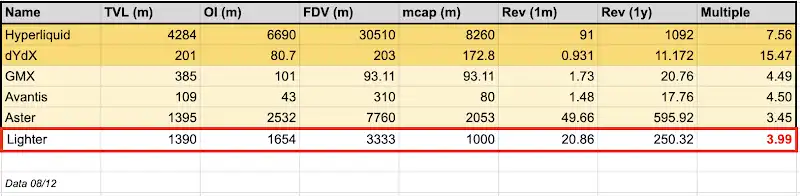
From the current OTC market perspective, Lighter's Fully Diluted Valuation (FDV) is around 3.3 billion USD. Assuming an airdrop ratio of 30%, its initial circulating market cap is approximately 750 million USD. For comparison, Hyperliquid's circulating market cap is as high as 8.2 billion USD.
Looking at revenue alone (Note: Lighter's revenue has not been market-validated for a year like Hyperliquid), by simply annualizing based on the revenue of the past month, Lighter's annualized revenue could reach 250 million USD. This means that Lighter's Price-to-Sales ratio (market cap/revenue) multiple is only 2.5 times, far lower than Hyperliquid's 7.6 times, ridiculously cheap.
Take a closer look at a closer competitor, Aster. Aster's TVL is comparable to Lighter's, with an Open Interest (OI) of about one billion more than Lighter's. However, its FDV reaches up to 7 billion, with a circulating market cap of around 2 billion. In contrast, Lighter's trading price is only one-third of Aster's.
Ask yourself: Even considering Aster's Binance/CZ halo, is Lighter's price at only one-third of Aster's reasonable? In my opinion, based on the current valuation, Lighter is severely undervalued fundamentally.
Looking at the fundamentals, you will find that only two tokens can sustain a high revenue multiple in the long run: Hyperliquid and DYDX. Why? The former has the most transparent buyback mechanism, while the latter has stood the test of time in this industry. Unlike other listed Perp Dexes, Lighter does not have a top-tier influencer like CZ or liquidity support from Coinbase to artificially pump, nor does it face the dilemma of "lack of real users" like other competitors.
Additionally, it is important to note that the over-the-counter market (SOTC) usually carries a discount because buyers bear default risks (if the opening price is twice as high as the OTC transaction price, sellers have an incentive to default), which causes people not to offer high prices in OTC but to wait and see the actual listing performance.
I choose to annualize based on the revenue of the last month for a reason: in the crypto world, everyone only has a 7-second memory, and no one has the ability to see clearly or trade for the future a year later. Therefore, only the immediate revenue of the last month is the most important indicator.
Funds Flow
The reason why Hyperliquid was able to break out on an independent trend is that many early LPs did not believe in its model. This led to those sharp-sighted retail investors sweeping all the chips and then selling to the belated buyers at a high price.
In conversations with a large number of VCs over the past few months, I have noticed a phenomenon: except for Paradigm, almost everyone missed out on Hyperliquid. This means that every VC with a liquidity fund (the vast majority of them do) will try to catch the next $HYPE.
Who is the next Hyperliquid? It's quite simple; just do a "pattern matching" between Lighter's storyline and Hyperliquid, and you'll find it's Lighter.
Looking at the token distribution, you will find: the large holders of Hyperliquid have also become the large holders and deep users of Lighter. The secret to wealth for this group of people is simple: Hold
errorToken Buyback
Passive spot buying is the only thing that can support the coin price. BTC has MicroStrategy's Saylor, ETH has Tom Lee, but for altcoins, the market only recognizes income buybacks. If you want to keep the price firm, you need passive buying in the form of buybacks. Hyperliquid understands this well.
Lighter is essentially a replica of Hyperliquid. Founder Vlad has made it clear that they will conduct buybacks. While you can't expect them to buy back 97% of the tokens, buying back 30% or 50% is reasonable. As long as there is an eight-figure (tens of millions) passive buy, this is attractive enough.
Note: In their $68 million financing (mainly for the insurance fund), the team has allocated some funds for token buybacks at TGE. This is similar to the early Hyperliquid's $75 million spot buy.
Deep Integration with Robinhood
Vlad Tenev (Robinhood's Vlad1) previously interned at Addepar for Vlad (Vlad2) from Lighter, and that's how they met. Robinhood is an investor in Lighter, and Vlad1 is also an advisor to Lighter.
There have been numerous rumors in the industry about using Lighter on Robinhood's chain. Lighter's goal is composability and will be integrated into Ethereum L1, ultimately achieving collateralized LLP token lending. This composability aligns with Robinhood's vision of "tokenizing everything" and putting everything on-chain.
While this is speculation, I support the argument that Robinhood will acquire a significant stake in Lighter (whether through tokens or equity). Given the similarity of their Payment for Order Flow (PFOF) models, I speculate that once Robinhood holds Lighter shares, it will redirect a significant portion of its traffic to Lighter. This will further strengthen this narrative.
RWA Trading
Although not limited to Lighter, RWA contract trading has proven to be a key early product-market fit. Data shows that Lighter's daily trading volume for all RWA products is $517 million, with an open interest (OI) of $271 million. Compared to Hyperliquid, Lighter is quickly catching up and even surpassing.
One key distinction is that Lighter's RWA service is not provided by a third party in the ecosystem, but rather self-operated. This makes coordination and onboarding of new assets smoother and faster. Additionally, Lighter's majority of trading volume comes from its FX contract, while Hyperliquid is mainly index contracts (80%). Ultimately, this will evolve into a pure competition of liquidity and order book depth to vie for users.
Hyperliquid's First True Competitor
The derivative market is growing rapidly, and despite a loyal fan base on Twitter shouting "Hyperliquid is the only one," the market is large enough to accommodate multiple top players. Robinhood has also opened up futures trading, as futures have a strong foothold in the crypto space and are indeed a superior trading method compared to options.
Solving the full collateral issue is the most critical challenge that Hyperliquid has outsourced to Flood and Fullstack Trade. To my knowledge, Flood is at least 6 months away from solving this problem. Lighter's larger team is more likely to tackle this challenge. Yes, Hyperliquid has a first-mover advantage, but if Lighter can swiftly integrate this feature, they may well take a slice of their cake.
Privacy
While Hyperliquid has built a cult-like community culture, its architecture has a fatal flaw for whales: complete transparency.
On Hyperliquid, leaderboards and on-chain data broadcast every large position, entry price, and liquidation point to the world. This turns trading into a PvP arena where predatory players like me can specifically hunt whales' liquidation orders and front-run large funds. Leveraging liquidation data to predict short-term tops and bottoms is traceable, and I know many traders continue to profit through this strategy.
Lighter positions itself as the antidote to this risk. By obfuscating trading flows and shielding position data, its operation is more akin to an on-chain dark pool rather than a standard DEX. For "smart money" and large funds, anonymity is not just a feature—it is a necessity. If you have a significant amount of funds, you absolutely cannot trade in a place that directly exposes your hand and liquidation point to the counterparty. As DeFi matures, venues that can protect user alpha will inevitably attract the largest flows of funds.
You may also like
AI Trading's Ultimate Test: Empower Your AI Strategy with Tencent Cloud to Win $1.88M & a Bentley
AI traders! Win $1.88M & a Bentley by crushing WEEX's live-market challenge. Tencent Cloud powers your AI Trading bot - can it survive the Feb 9 finals?

Russia’s Largest Bitcoin Miner BitRiver Faces Bankruptcy Crisis – What Went Wrong?
Key Takeaways BitRiver, the largest Bitcoin mining operator in Russia, faces a bankruptcy crisis due to unresolved debts…

Polymarket Predicts Over 70% Chance Bitcoin Will Drop Below $65K
Key Takeaways Polymarket bettors forecast a 71% chance for Bitcoin to fall below $65,000 by 2026. Strong bearish…

BitMine Reports 4.285M ETH Holdings, Expands Staked Position With Massive Reward Outlook
Key Takeaways BitMine Immersion Technologies holds 4,285,125 ETH, which is approximately 3.55% of Ethereum’s total supply. The company…

US Liquidity Crisis Sparked $250B Crash, Not a ‘Broken’ Crypto Market: Analyst
Key Takeaways: A massive $250 billion crash shook the cryptocurrency markets, attributed largely to liquidity issues in the…

Vitalik Advocates for Anonymous Voting in Ethereum’s Governance — A Solution to Attacks?
Key Takeaways Vitalik Buterin proposes a two-layer governance framework utilizing anonymous voting to address collusion and capture attacks,…

South Korea Utilizes AI to Pursue Unfair Crypto Trading: Offenders Face Severe Penalties
Key Takeaways South Korea is intensifying its use of AI to crack down on unfair cryptocurrency trading practices.…

Average Bitcoin ETF Investor Turns Underwater After Major Outflows
Key Takeaways: U.S. spot Bitcoin ETFs hold approximately $113 billion in assets, equivalent to around 1.28 million BTC.…

Japan’s Biggest Wealth Manager Adjusts Crypto Strategy After Q3 Setbacks
Key Takeaways Nomura Holdings, Japan’s leading wealth management firm, scales back its crypto involvement following significant third-quarter losses.…
CFTC Regulatory Shift Could Unlock New Opportunities for Coinbase Prediction Markets
Key Takeaways: The U.S. Commodity Futures Trading Commission (CFTC) is focusing on clearer regulations for crypto-linked prediction markets,…
Hong Kong Set to Approve First Stablecoin Licenses in March — Who’s In?
Key Takeaways Hong Kong’s financial regulator, the Hong Kong Monetary Authority (HKMA), is on the verge of approving…

BitRiver Founder and CEO Igor Runets Detained Over Tax Evasion Charges
Key Takeaways: Russian authorities have detained Igor Runets, CEO of BitRiver, on allegations of tax evasion. Runets is…

Crypto Investment Products Struggle with $1.7B Outflows Amid Market Turmoil
Key Takeaways: The recent $1.7 billion outflow in the crypto investment sector represents a second consecutive week of…

Why Is Crypto Down Today? – February 2, 2026
Key Takeaways: The crypto market has seen a downturn today, with a significant decrease of 2.9% in the…

Nevada Court Temporarily Bars Polymarket From Offering Contracts in the State
Key Takeaways A Nevada state court has temporarily restrained Polymarket from offering event contracts in the state, citing…

Bitcoin Falls Below $80K As Warsh Named Fed Chair, Triggers $2.5B Liquidation
Key Takeaways Bitcoin’s price tumbled below the crucial $80,000 mark following the announcement of Kevin Warsh as the…

Strategy’s Bitcoin Holdings Face $900M in Losses as BTC Slips Below $76K
Key Takeaways Strategy Inc., led by Michael Saylor, faces over $900 million in unrealized losses as Bitcoin price…
Trump-Linked Crypto Company Secures $500M UAE Investment, Sparking Conflict Concerns
Key Takeaways A Trump-affiliated crypto company, World Liberty Financial, has garnered $500 million from UAE investors, igniting conflict…
AI Trading's Ultimate Test: Empower Your AI Strategy with Tencent Cloud to Win $1.88M & a Bentley
AI traders! Win $1.88M & a Bentley by crushing WEEX's live-market challenge. Tencent Cloud powers your AI Trading bot - can it survive the Feb 9 finals?
Russia’s Largest Bitcoin Miner BitRiver Faces Bankruptcy Crisis – What Went Wrong?
Key Takeaways BitRiver, the largest Bitcoin mining operator in Russia, faces a bankruptcy crisis due to unresolved debts…
Polymarket Predicts Over 70% Chance Bitcoin Will Drop Below $65K
Key Takeaways Polymarket bettors forecast a 71% chance for Bitcoin to fall below $65,000 by 2026. Strong bearish…
BitMine Reports 4.285M ETH Holdings, Expands Staked Position With Massive Reward Outlook
Key Takeaways BitMine Immersion Technologies holds 4,285,125 ETH, which is approximately 3.55% of Ethereum’s total supply. The company…
US Liquidity Crisis Sparked $250B Crash, Not a ‘Broken’ Crypto Market: Analyst
Key Takeaways: A massive $250 billion crash shook the cryptocurrency markets, attributed largely to liquidity issues in the…
Vitalik Advocates for Anonymous Voting in Ethereum’s Governance — A Solution to Attacks?
Key Takeaways Vitalik Buterin proposes a two-layer governance framework utilizing anonymous voting to address collusion and capture attacks,…


 App
App