
- Buy Crypto
- Markets
- Futures
- Spot
- Copy Trade
 Earn
Earn- More
Polygon Ecosystem Dilemma: The "Borrowing Chickens to Lay Eggs" Proposal Causes Concerns, AAVE and Lido Withdrew Collectively

Original title: "Polygon Ecological Crisis: AAVE and Lido collectively withdraw from the market, the trouble is caused by the "borrowing chickens to lay eggs" proposal"
Original author: Frank, PANews
As an important promoter of multi-chain interoperability, zero-knowledge proof applications, and DeFi and NFT ecosystems, Polygon once shined in the last bull market cycle. However, in the past year, many public chain projects such as Polygon have failed to achieve new breakthroughs, but have gradually been submerged in the light of new competitors such as Solana, Sui or Base. When Polygon returned to the discussion on social media again, it was not because of any major updates, but because of the withdrawal of ecological partners such as AAVE and Lido.
"Borrowing Chickens to Lay Eggs" Proposal Raises Concerns
On December 16, Aave contributor team Aave Chan released a proposal in the community to withdraw its lending services from Polygon's Proof of Stake (PoS) chain. The proposal, written by Aave Chan founder Marc Zeller, aims to gradually phase out Aave's lending protocol on Polygon to prevent possible security risks in the future. Aave is the largest decentralized application on Polygon, with deposits on the PoS chain exceeding $466 million.
Coincidentally, on the same day, the liquidity pledge agreement Lido announced that Lido on the Polygon network will be officially deactivated in the next few months. The Lido community said that the strategic refocus on Ethereum and the lack of scalability of Polygon POS were the reasons for deactivating Lido on the Polygon network.
Polygon suffered a heavy blow after losing two major ecological applications in one day. The main reason all came from the "Polygon PoS Cross-Chain Liquidity Plan" Pre-PIP improvement proposal released by the Polygon community on December 13. The main goal of the proposal is to propose the use of more than $1 billion in stablecoin reserves held on the PoS chain bridge to generate income.
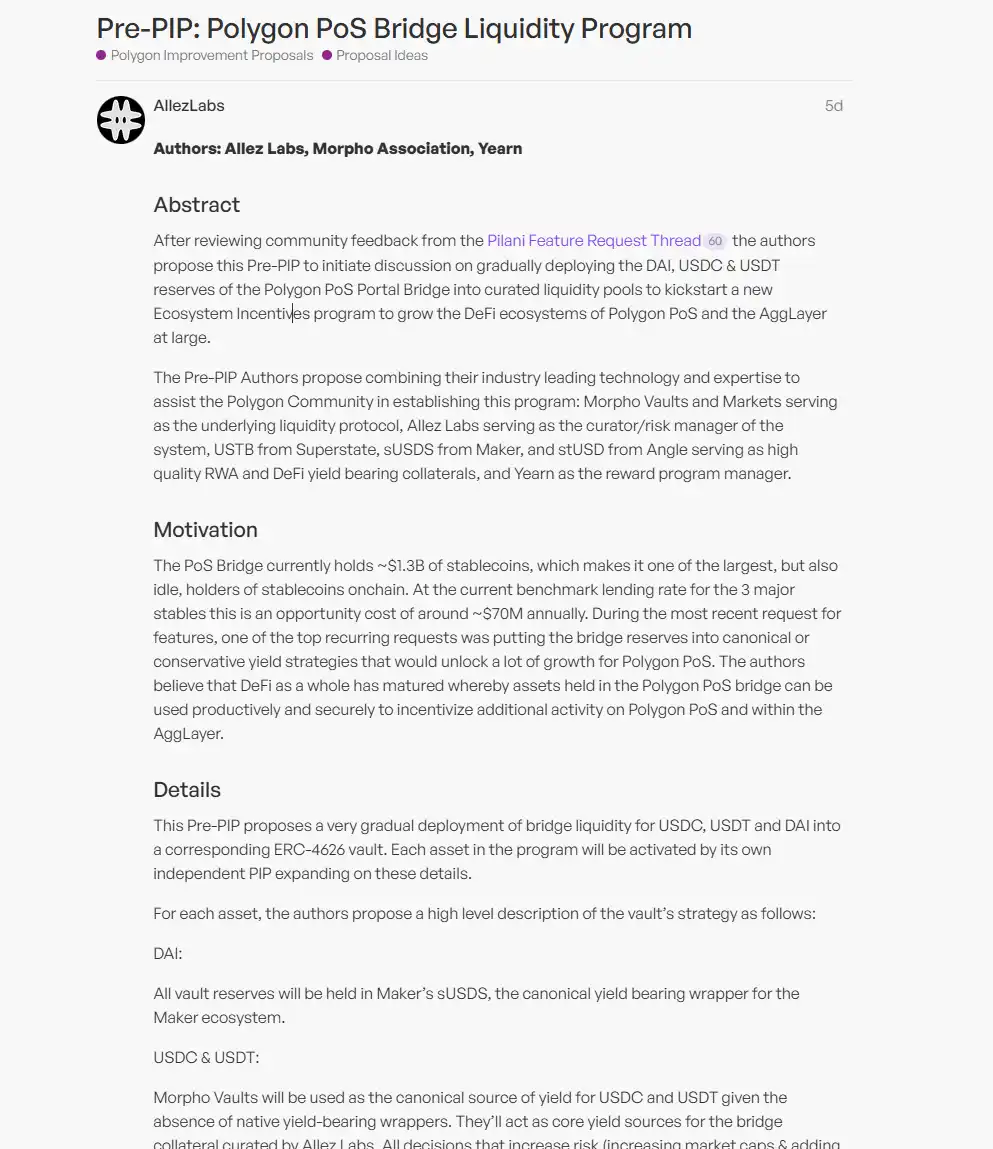
It is understood that the Polygon PoS bridge holds approximately $1.3 billion in stablecoin reserves. The community recommends deploying these idle funds into carefully selected liquidity pools to generate income and promote the development of the Polygon ecosystem. Based on the current loan interest rate, these funds may bring in approximately $70 million in income per year.
The proposal suggests that these funds be gradually invested in vaults that comply with the ERC-4626 standard. Specific strategies include:
DAI: Deposit Maker's sUSDS, the official yield token of the Maker ecosystem.
USDC and USDT: Through Morpho Vaults as the main source of income, Allez Labs is responsible for risk management. Initial markets include Superstate's USTB, Maker's sUSDS, and Angle's stUSD.
In addition, Yearn will manage the new ecosystem incentive program, using these proceeds to incentivize activities in Polygon PoS and the broader AggLayer ecosystem.
It is worth noting that the signatures of this proposal are Allez Labs, Morpho Association, and Yearn. According to Defillama data on December 17, Polygon's total TVL is 1.23 billion US dollars, of which AAVE's TVL is about 465 million US dollars, accounting for about 37.8%. Yearn Finance's TVL ranks 26th in the ecosystem, with a TVL of about 3.69 million US dollars. This may explain why AAVE proposed to withdraw from Polygon for security reasons.
Obviously, from AAVE's perspective, this proposal is to take AAVE's money and put it in other lending agreements to earn interest. As the largest application of Polygon POS cross-chain bridge funds, AAVE cannot benefit from such a proposal, but instead has to bear the risk of fund security.
However, Lido's withdrawal may have nothing to do with this proposal. After all, Lido's proposal and vote on re-evaluating Polygon were released a month ago, but it just happened to be released at this time.
A helpless move due to weak ecological development
If the AAVE withdrawal proposal is officially passed, the TVL on Polygon will drop to $765 million, which is no longer possible to achieve the $1 billion fund reserve mentioned in the Pre-PIP improvement proposal. Uniswap, which ranks second in the ecosystem, has a TVL of about $390 million. If Uniswap also follows up with a similar plan to AAVE, the TVL on Polygon will drop sharply to around $370 million. Not only will the annual interest-bearing target of $70 million not be achieved, but all aspects of the entire ecosystem will be affected, such as the price of governance tokens, active users, etc. Perhaps the loss will be far more than $70 million.
So, judging from this result, this proposal does not seem to be a wise move. Why did the Polygon community propose this plan? In the past year of development, what is the state of the Polygon ecosystem?
The most prosperous time for the Polygon ecosystem was in June 2021, when the total TVL reached 9.24 billion US dollars, which is 7.5 times that of today. As time goes by, Polygon's TVL curve has been declining all the way. Since June 2022, it has been maintained at around 1.3 billion US dollars, without much ups and downs. By 2023, it had once fallen to around 600 million US dollars. In 2024, the market rebounded, and Polygon's TVL volume was still below 1 billion US dollars in most cases. It barely recovered to more than 1 billion US dollars from October.

In terms of the number of active addresses, Polygon PoS had about 439,000 active addresses on October 29, which is almost the same as the data a year ago. Although the number of active addresses of Polygon PoS has increased significantly from March to August this year, reaching 1.65 million at one time. But for some reason, it cooled down rapidly when the market was hottest. 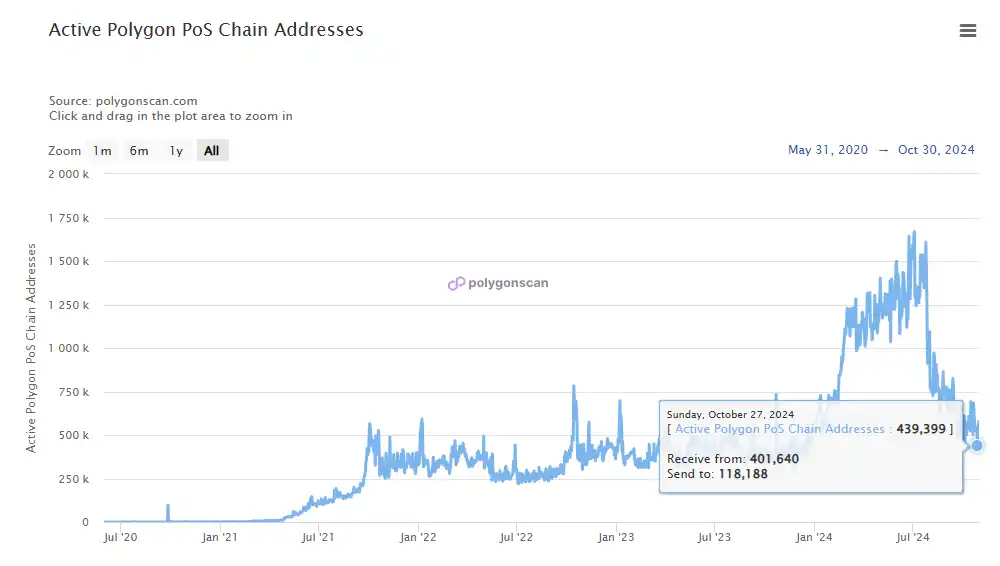
The market performance of the token was also poor. From March to November 2024, the price of POL tokens did not follow the rise of the Bitcoin and other markets, but fell all the way, from $1.3 at the beginning of the year to $0.28, a drop of more than 77%. It has only started to rebound in the past one or two months. The price has rebounded to around $0.6 recently, but it still needs to increase by about 5 times from the historical high of nearly $3.
Technological innovation + brand upgrade is not as good as "giving money"
Polygon has not given up on technology and products despite the weak development of the ecosystem. It has repeatedly released voices on technological innovation and product layout in the past year. The most eye-catching performance is naturally the development of the prediction market Polymarket in the past year. In addition, in October, Polygon released a new unified blockchain ecosystem AggLayer. According to the official introduction, Agglayer = unified chain (L1, L2, L∞), but it is obvious that the positioning of this new ecosystem does not seem to be easy to understand. In November, the official also published an article to explain AggLayer.
In addition, Polygon Plonky3, a ZK proof system toolkit within the ecosystem, has become the fastest zero-knowledge proof system. Vitalik also interacted on Twitter and said, "You won the game."
In addition to technology, this year many old public chains like to reshape their brands by changing their names and changing their coins. Polygon has already reshaped its brand, changing its name from Matic to Polygon. And for the current market environment, non-disruptive technological innovation seems to be difficult to become a narrative advantage for a project. This is indeed a cruel fact for projects such as Polygon that are still obsessed with technological innovation or hope to reshape their brands through integration.
What can really attract users and keep their attention is often reward distribution or incentive plans, such as Hyperliquid, which is in the limelight recently. Polygon wants to reform in this regard, but there are obviously not many cards available. In terms of on-chain fees, Polygon only generates tens of thousands of dollars in fees every day, and these revenues cannot arouse users' interest. So, there is the "borrowing chickens to lay eggs" proposal mentioned at the beginning.
But obviously, the owner of the "hen" does not agree with this business, and Polygon may lose more because of it. Overall, the fundamental reason for the stagnation of Polygon's ecological development is that it lacks sufficient user incentives and new narrative driving force. Faced with intensified market competition, Polygon needs to find more attractive market strategies in addition to technological innovation. This is also the common dilemma of most old chains at present.
You may also like

HYPE Price Target Achieves $50 as Hyperliquid Reduces Team Token Unlock by 90% — Assessing The Rally’s Longevity
Key Takeaways Hyperliquid significantly cut its monthly token unlocks by 90%, sparking renewed interest in its HYPE token’s…

Hong Kong-Based OSL Group Launches $200M Equity Raise for Stablecoin and Payments Expansion
Key Takeaways OSL Group, a prominent digital asset platform in Asia, has initiated a significant $200 million equity…

Gold Price Prediction: Current Trends and Future Outlook for January 28, 2026
Key Takeaways Gold and silver prices play a significant role in the global economy, reflecting both market trends…

GameStop 2.0? Why Robinhood’s CEO Advocates Tokenization for Trading Halts
Key Takeaways Tokenized stocks are seen as a solution to counteract the disruptions seen in traditional equity markets…

Central Bank of the UAE Endorses First USD-Backed Stablecoin
Key Takeaways The UAE Central Bank has endorsed the first US dollar-backed stablecoin, USDU, to streamline compliant settlements…

Can the Gold Price Rise to $6,000?
Key Takeaways Gold prices in 2026 have experienced dramatic surges, reaching unprecedented levels in just the first month…

Solana Loses Major Portion of Validators as Smaller Nodes Exit: Concerns Over Centralization
Key Takeaways: Solana has experienced a significant drop in active validators from a high of 2,560 in March…

Gold Price Prediction as Tom Lee Says Metals Rally Could Hit Crypto
Key Takeaways: Gold recently reached an all-time high of $5,598, reflecting a strong investor shift towards safe-haven assets…

Bitcoin’s Historical Bottom Indicator Points to $62K – Could BTC Fall That Low?
Key Takeaways Bitcoin is nearing a critical support level of \$62,000, with key indicators suggesting potential further declines.…

Talos Raises $45M Series B Extension Backed by Robinhood, Bringing Total Funding to $150M
Key Takeaways: Talos, a leading provider of institutional digital asset trading technology, has raised $45 million in a…

What is the Next Milestone for Gold Prices and Will It Reach $6,000 by Year End?
Key Takeaways: Gold prices recently crossed the $5,000 per ounce mark, spurring predictions of further increases amidst global…

Bitcoin Price Prediction: Binance Inflows Just Hit a 4-Year Low – Violent Move Above $100K is Next
Key Takeaways: Bitcoin inflows into Binance have dropped to their lowest in four years, potentially signaling a tight…

Gold to $10,000 and Silver to $150: My Wild, Or Perhaps Not-So-Wild 2026 Price Predictions
Key Takeaways Geopolitical uncertainties are significantly driving up the demand for gold and silver, suggesting the prices may…

Hong Kong Enhances Gold Market Access Through Hang Seng Gold ETF and Tokenized Units
Key Takeaways: The Hang Seng Gold ETF offers Hong Kong investors direct access to gold by launching a…

XRP “Millionaire” Wallets Rise Despite Modest Price Dip: Santiment
Key Takeaways: The count of XRP wallets holding over 1 million tokens is increasing, despite a slight dip…
Russia Caps Crypto Investments at $4,000 Annually for Non-Qualified Investors – Will Others Follow Suit?
Key Takeaways Russia’s proposal sets a $4,000 annual investment limit for non-qualified crypto investors, sparking discussions on regulatory…
Japan’s Metaplanet Announces $137 Million Capital Raise Via Third-Party Allotment
Key Takeaways Japanese firm Metaplanet Inc. has strategized a $137 million capital raising through the third-party allotment of…

Crypto Price Prediction for January 28 – XRP, Solana, Bitcoin
Key Takeaways Bitcoin price recently hit $90,000 but struggled to maintain this peak. XRP and Solana are following…
HYPE Price Target Achieves $50 as Hyperliquid Reduces Team Token Unlock by 90% — Assessing The Rally’s Longevity
Key Takeaways Hyperliquid significantly cut its monthly token unlocks by 90%, sparking renewed interest in its HYPE token’s…
Hong Kong-Based OSL Group Launches $200M Equity Raise for Stablecoin and Payments Expansion
Key Takeaways OSL Group, a prominent digital asset platform in Asia, has initiated a significant $200 million equity…
Gold Price Prediction: Current Trends and Future Outlook for January 28, 2026
Key Takeaways Gold and silver prices play a significant role in the global economy, reflecting both market trends…
GameStop 2.0? Why Robinhood’s CEO Advocates Tokenization for Trading Halts
Key Takeaways Tokenized stocks are seen as a solution to counteract the disruptions seen in traditional equity markets…
Central Bank of the UAE Endorses First USD-Backed Stablecoin
Key Takeaways The UAE Central Bank has endorsed the first US dollar-backed stablecoin, USDU, to streamline compliant settlements…
Can the Gold Price Rise to $6,000?
Key Takeaways Gold prices in 2026 have experienced dramatic surges, reaching unprecedented levels in just the first month…


 App
App