
- Buy Crypto
- Markets
- Futures
- Spot
- Copy Trade
 Earn
Earn- More
Trump's Tariffs Hit Global Economy, Can Cryptocurrency Be a Safe Haven?

Original Article Title: Crypto's Edge in a Tariff World
Original Article Author: Marco Manoppo, Investor at Primitive Ventures
Original Article Translation: Deep Translations
Editor's Note: The article explores the value of cryptocurrency as a hedge in the context of a global trade war and escalating tariff barriers. The author points out that tariff policies lead to higher inflation, market distortions, and historical evidence shows more harm than good. Cryptocurrency, with its decentralization, sovereignty, and cross-border liquidity, may become a new asset choice to deal with geopolitical uncertainties and economic chaos. Although cryptocurrency (such as Bitcoin) has not fully demonstrated its "digital gold" hedge properties, its borderless economic system is challenging the traditional financial order.
The following is the original content (slightly restructured for better readability):
As the trade war reshapes the global economic landscape, cryptocurrency once again has the opportunity to prove its value as a hedge against chaos.
Background Context
"Madness is rare in individual, but in groups, parties, nations, and ages it is the rule." — Friedrich Nietzsche
The market is in intense turmoil. As the Prime Minister of Singapore said, the United States is essentially abandoning the economic system it has built with its own hands. The cornerstone of the global economic system is gradually being eroded. The author believes that if the situation is not quickly brought under control, more areas will face collapse.
Cryptocurrency has always been a macro-dominant asset. One of the core arguments that Bitcoin purists advocate throughout the year is "sovereignty."
In short, Bitcoin as an asset can hedge against geopolitical uncertainty because it is a theoretically harder form of money than gold. But so far, this theory has not been validated: Bitcoin's transactional characteristics are closer to the Nasdaq beta coefficient, and its performance during turbulent times is far inferior to gold. Will this time be different?
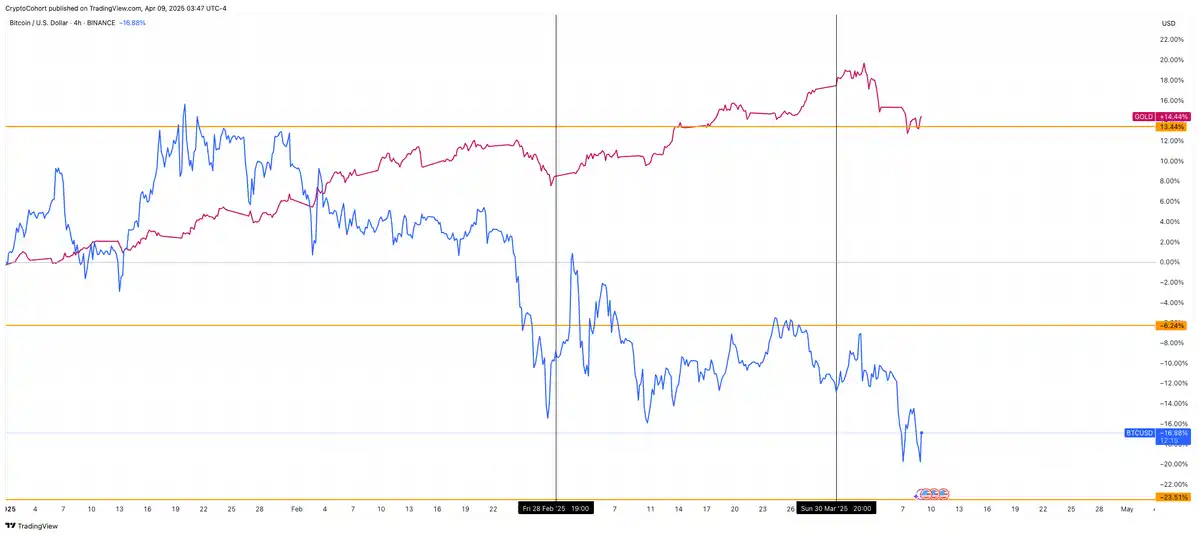
Gold vs Bitcoin Price Trend Chart
Essence of Tariffs Analysis
If you want to witness the intellectual self-pleasure, there is no better time than now than scrolling through Twitter — everyone suddenly becomes a macroeconomist. To avoid adding to the cognitive burden, the author only lists objective facts:
· Tariffs fundamentally create inefficiencies, raise consumer prices, distort free markets, trigger economic retaliation actions, and escalate conflicts.
· A typical case can be traced back to the 1980s: Despite President Ronald Reagan initially implementing tariffs in some areas, he eventually acknowledged their drawbacks. He clearly stated in a 1987 broadcast speech: "Protectionism becomes destructionism; it costs jobs."
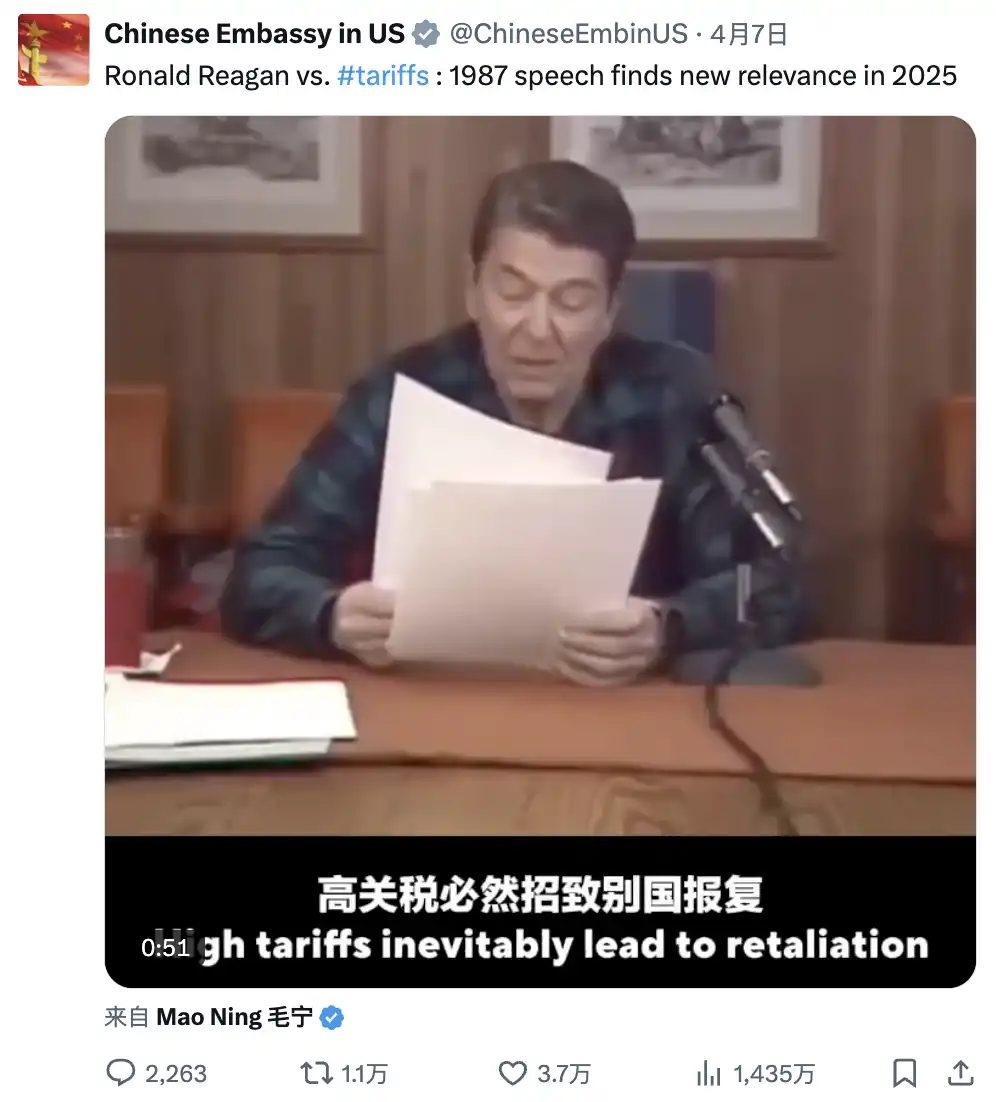
Chinese Embassy in the U.S. Twitter, Reagan vs. Tariffs: The 1987 Speech Reappears in 202 with Realistic Significance, by Maoning
Why Tariffs Are Not a Good Thing
First, the effective tariffs currently implemented by Trump are the highest level in over 100 years - but there are still many reasons against it:
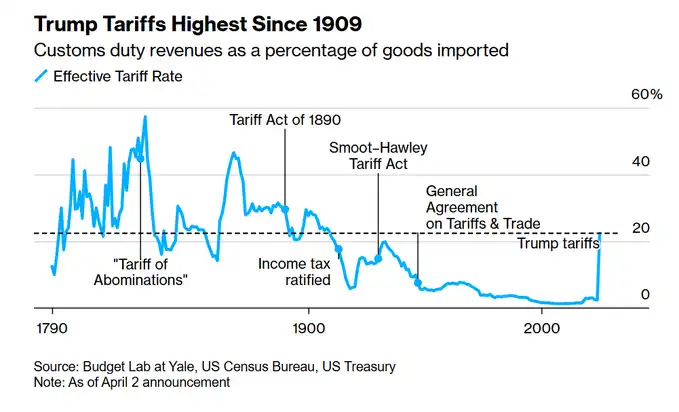
Economic Impact and Inflation
At the core of tariffs is a tax on imported goods, paid by domestic importers, and these costs are often passed on to consumers. Historical and contemporary evidence consistently shows that tariffs directly lead to consumer price increases.
· For example, according to the Tax Foundation, recent U.S. tariffs will increase the average tax burden per household by over $2,100.
· The Yale Budget Model estimates that the annual impact on each household could be as high as $3,800.
· UBS Group predicts that just a 10% general tariff could trigger a 10% stock market decline.
Misconceptions About Trade Deficits
One of the core reasons cited by supporters of tariffs is the large trade deficit. However, a trade deficit itself does not mean a weak economy or exploitation.
· It simply indicates that a country imports more goods than it exports, often driven by strong consumption demand, a strong currency, or comparative advantages in services rather than goods.
· For example, the U.S. has long enjoyed a significant surplus in high-value service sectors such as finance, technology, and high-end manufacturing. Imposing tariffs on goods trade deficits, especially in cases where many countries lack the wealth or demand to import U.S. products, will artificially raise prices for American consumers.
· Countries like Cambodia and Kiribati are typical examples of this situation; their trade deficits exist because these countries are too poor to buy U.S.-made products, not because they engage in unfair trade.
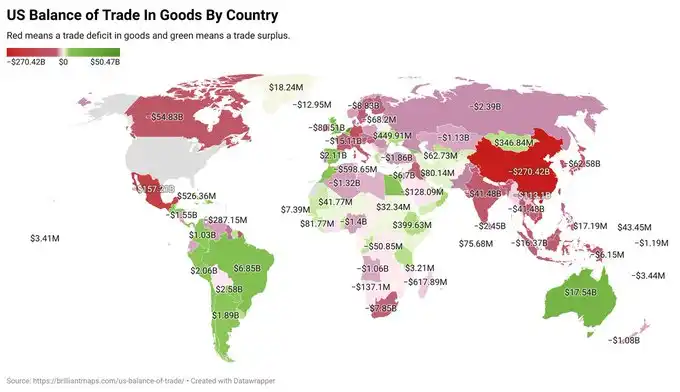
Even countries with a trade surplus with the United States are being hit by tariffs.
Historical Consequences of Tariffs
Historically, protectionist tariffs have often led to economic downturns rather than prosperity.
· Famous examples include the Tariff of 1828 and the notorious 1930 Smoot-Hawley Tariff Act. The latter, through triggering retaliatory tariffs, shrinking global trade, and deepening global economic woes, exacerbated the Great Depression.
· Economists generally agree that history has repeatedly shown that tariffs often do more harm than good.
· Even McKinley, often seen as a tariff inspiration by Trump, began to oppose tariffs by the end of his presidency, acknowledging their negative impact on the economy.
The Myth of Inefficiency and Job Creation
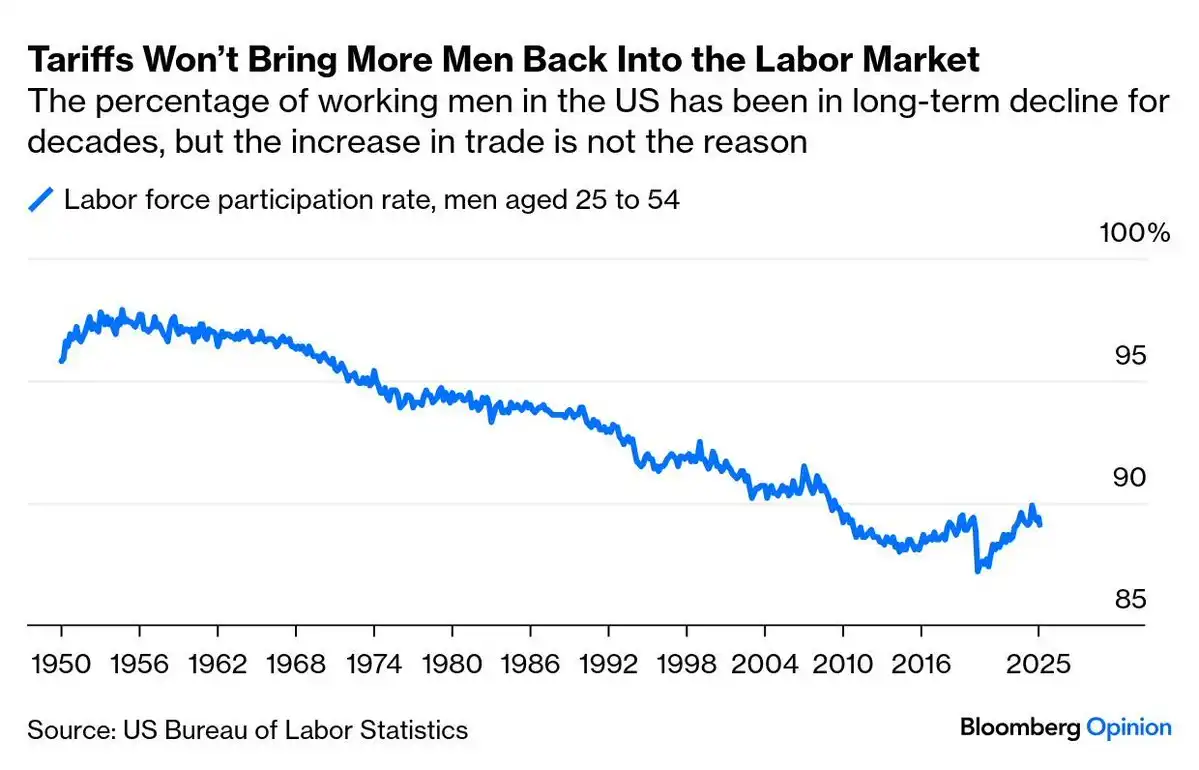
Tariffs are often promised as a means to revitalize domestic manufacturing and create job opportunities. However, modern manufacturing is highly automated and capital-intensive, meaning that even if factories return to the U.S., they require fewer workers.
· With global automation accelerating, reshoring driven by tariffs will not bring about the job boom politicians often promise.
· In fact, many manufacturers either absorb higher costs or slightly less efficiently shift to other low-cost countries, leading to minimal new domestic job creation.
· The unintended consequence is often economic stagnation or decline. When Argentina adopted protectionist policies under Peronism, it shifted from one of the world's wealthiest nations to an economic wasteland and has yet to fully recover.
Strategic Risks in Global Trade Dynamics
Tariffs may inadvertently strengthen geopolitical adversaries by triggering global trade realignments. Historical evidence emphasizes that trade wars are globally harmful, leading to economic contractions, supply chain instability, and significant harm to consumer welfare.
· For example, the widespread tariffs recently implemented by Trump have not only raised domestic prices but also, by disrupting the supply chains of countries competing with China, inadvertently benefited China.
· Countries like Vietnam, previously positioned as alternatives to China, are now facing steep tariffs that may push production back to China despite the high tariffs due to China's economies of scale and manufacturing efficiency.
· Furthermore, tariffs may trigger retaliatory measures from trading partners, igniting a trade war. The European Union has hinted at possible retaliatory tariffs, especially targeting U.S. tech companies, increasing the risk of a broader economic conflict.
Market Dislikes Uncertainty
The market dislikes uncertainty, and tariffs bring exactly that. Trump's recent tariff statements have caused severe market turmoil, with stock market volatility sharply increasing.
· Sectors such as retail, technology, consumer goods, and manufacturing are particularly affected, as they anticipate rising input costs and reduced consumer spending.
· Furthermore, due to decreased global trust and reduced capital inflows, tariffs have weakened the dollar, leading to broader economic instability. This volatility not only undermines consumer and business confidence but also suppresses investment, further hindering economic growth.
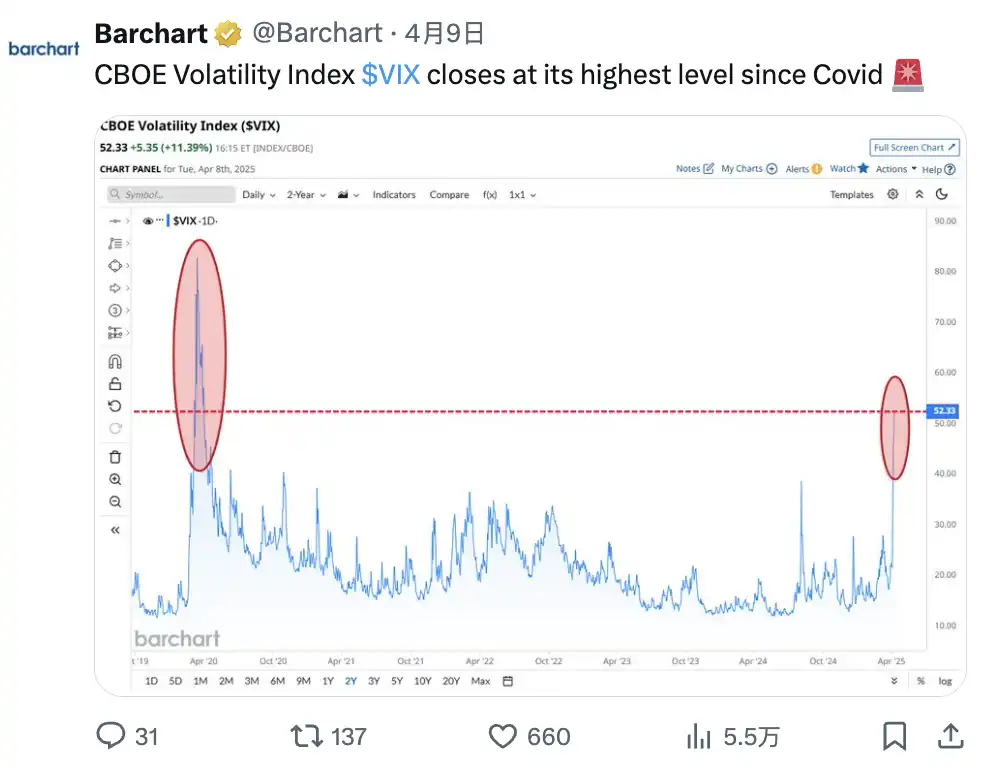
CBOE Volatility Index $VIX closed at its highest level since the COVID-19 pandemic
Misconception of National Security
National security is one of the few legitimate reasons that can be used for limited strategic tariffs.
· However, the current tariff regime is widely and indiscriminately applied, severely undermining the credibility of the true national security argument.
· The current practice does not strategically protect key industries but rather indiscriminately raises costs on almost all imported goods, while harming both strategic and non-strategic sectors.
Cryptocurrency: Hedging Chaos
Tariffs and trade wars strongly remind people that nations are ultimately made up of a group of humans, driven by inherent emotions and tribal decisions—decisions designed to benefit their own group, even if, from a broader perspective, they are irrational. In such an environment, cryptocurrency becomes especially important as it represents true personal ownership and sovereignty, providing the highest form of economic agency in an increasingly unpredictable world influenced by geopolitical manipulations.
Cryptocurrency → A super digital economic system used for chaos hedging.
As Ray Dalio aptly pointed out, trade conflicts rarely truly concern trade but are more about identity, pride, domestic politics, and emotional interests. Meanwhile, beneath the noise of geopolitical conflicts, cryptocurrency is quietly building an alternative economic infrastructure where tariffs and traditional borders no longer exist.
Traditional governments struggle to accurately track digital services and their intangible economic impact in trade balance calculations. Cryptocurrency takes this to a whole new level, encapsulating digital activities and transactions beyond borders, tariffs, and political friction.
Technically, we still need to figure out how to appropriately integrate the on-chain properties of cryptocurrency with new business models (referencing my earlier point), but this is still a work in progress.
Conclusion: When government actions become unpredictable or fail to safeguard the interests of the people, how should global sovereign individuals allocate resources? Cryptocurrency has provided its own answer.
You may also like

Russia’s Largest Bitcoin Miner BitRiver Faces Bankruptcy Crisis – What Went Wrong?
Key Takeaways BitRiver, the largest Bitcoin mining operator in Russia, faces a bankruptcy crisis due to unresolved debts…

Polymarket Predicts Over 70% Chance Bitcoin Will Drop Below $65K
Key Takeaways Polymarket bettors forecast a 71% chance for Bitcoin to fall below $65,000 by 2026. Strong bearish…

BitMine Reports 4.285M ETH Holdings, Expands Staked Position With Massive Reward Outlook
Key Takeaways BitMine Immersion Technologies holds 4,285,125 ETH, which is approximately 3.55% of Ethereum’s total supply. The company…

US Liquidity Crisis Sparked $250B Crash, Not a ‘Broken’ Crypto Market: Analyst
Key Takeaways: A massive $250 billion crash shook the cryptocurrency markets, attributed largely to liquidity issues in the…

Vitalik Advocates for Anonymous Voting in Ethereum’s Governance — A Solution to Attacks?
Key Takeaways Vitalik Buterin proposes a two-layer governance framework utilizing anonymous voting to address collusion and capture attacks,…

South Korea Utilizes AI to Pursue Unfair Crypto Trading: Offenders Face Severe Penalties
Key Takeaways South Korea is intensifying its use of AI to crack down on unfair cryptocurrency trading practices.…

Average Bitcoin ETF Investor Turns Underwater After Major Outflows
Key Takeaways: U.S. spot Bitcoin ETFs hold approximately $113 billion in assets, equivalent to around 1.28 million BTC.…

Japan’s Biggest Wealth Manager Adjusts Crypto Strategy After Q3 Setbacks
Key Takeaways Nomura Holdings, Japan’s leading wealth management firm, scales back its crypto involvement following significant third-quarter losses.…
CFTC Regulatory Shift Could Unlock New Opportunities for Coinbase Prediction Markets
Key Takeaways: The U.S. Commodity Futures Trading Commission (CFTC) is focusing on clearer regulations for crypto-linked prediction markets,…
Hong Kong Set to Approve First Stablecoin Licenses in March — Who’s In?
Key Takeaways Hong Kong’s financial regulator, the Hong Kong Monetary Authority (HKMA), is on the verge of approving…

BitRiver Founder and CEO Igor Runets Detained Over Tax Evasion Charges
Key Takeaways: Russian authorities have detained Igor Runets, CEO of BitRiver, on allegations of tax evasion. Runets is…

Crypto Investment Products Struggle with $1.7B Outflows Amid Market Turmoil
Key Takeaways: The recent $1.7 billion outflow in the crypto investment sector represents a second consecutive week of…

Why Is Crypto Down Today? – February 2, 2026
Key Takeaways: The crypto market has seen a downturn today, with a significant decrease of 2.9% in the…

Nevada Court Temporarily Bars Polymarket From Offering Contracts in the State
Key Takeaways A Nevada state court has temporarily restrained Polymarket from offering event contracts in the state, citing…

Bitcoin Falls Below $80K As Warsh Named Fed Chair, Triggers $2.5B Liquidation
Key Takeaways Bitcoin’s price tumbled below the crucial $80,000 mark following the announcement of Kevin Warsh as the…

Strategy’s Bitcoin Holdings Face $900M in Losses as BTC Slips Below $76K
Key Takeaways Strategy Inc., led by Michael Saylor, faces over $900 million in unrealized losses as Bitcoin price…
Trump-Linked Crypto Company Secures $500M UAE Investment, Sparking Conflict Concerns
Key Takeaways A Trump-affiliated crypto company, World Liberty Financial, has garnered $500 million from UAE investors, igniting conflict…

Billionaire Michael Saylor’s Strategy Buys $75M of More Bitcoin – Bullish Signal?
Key Takeaways Michael Saylor’s firm, Strategy, has significantly increased its Bitcoin holdings by acquiring an additional 855 BTC…
Russia’s Largest Bitcoin Miner BitRiver Faces Bankruptcy Crisis – What Went Wrong?
Key Takeaways BitRiver, the largest Bitcoin mining operator in Russia, faces a bankruptcy crisis due to unresolved debts…
Polymarket Predicts Over 70% Chance Bitcoin Will Drop Below $65K
Key Takeaways Polymarket bettors forecast a 71% chance for Bitcoin to fall below $65,000 by 2026. Strong bearish…
BitMine Reports 4.285M ETH Holdings, Expands Staked Position With Massive Reward Outlook
Key Takeaways BitMine Immersion Technologies holds 4,285,125 ETH, which is approximately 3.55% of Ethereum’s total supply. The company…
US Liquidity Crisis Sparked $250B Crash, Not a ‘Broken’ Crypto Market: Analyst
Key Takeaways: A massive $250 billion crash shook the cryptocurrency markets, attributed largely to liquidity issues in the…
Vitalik Advocates for Anonymous Voting in Ethereum’s Governance — A Solution to Attacks?
Key Takeaways Vitalik Buterin proposes a two-layer governance framework utilizing anonymous voting to address collusion and capture attacks,…
South Korea Utilizes AI to Pursue Unfair Crypto Trading: Offenders Face Severe Penalties
Key Takeaways South Korea is intensifying its use of AI to crack down on unfair cryptocurrency trading practices.…


 App
App